Astaxanthin: The powerful antioxidant making waves in beauty and wellness
Meet astaxanthin: the rosy-red antioxidant quietly making waves in the world of natural health and beauty nutrition. Found naturally in wild salmon, prawns and microalgae, this remarkable compound offers a breadth of evidence-backed benefits for your skin, eyes, energy levels and beyond.

Contents
- What on earth is astaxanthin, and why is it so popular?
- How does astaxanthin compare to other antioxidants?
- Can astaxanthin really improve your skin?
- Can astaxanthin support your eye health?
- Can astaxanthin help with inflammation?
- How does astaxanthin support your workout recovery?
- What are the best food sources of astaxanthin?
- How do I choose the right astaxanthin supplement?
- Is astaxanthin worth adding to my wellness routine?
What on earth is astaxanthin, and why is it so popular?
There’s a quiet revolution happening in natural health. It’s not loud or flashy. But it’s turning heads, and for very good reason. The ingredient at the centre of it all? A rosy-red pigment with a name that sounds like it belongs in a chemistry exam: astaxanthin (pronounced as-ta-ZAN-thin).
You might not have heard of it yet. But the chances are, you’ve already seen it. That vivid pink-orange hue in wild salmon, the deep red of a cooked lobster, the rosy blush of a flamingo’s feathers: astaxanthin is behind all of it. It’s a natural pigment and one of the most researched antioxidants in nutritional science today.
So why the buzz? Because astaxanthin doesn’t just do one thing well. It does a lot of things well. From protecting your skin against visible signs of ageing to supporting your eyes, joints and energy levels too. Few natural compounds can match this range of support.
Where does it come from, and what gives it that striking red-pink colour?
Astaxanthin belongs to a group of pigments called carotenoids. These are the same pigments that make carrots orange and tomatoes red. But astaxanthin stands out, even among its carotenoid cousins.
Its main natural source is a tiny freshwater microalgae called Haematococcus pluvialis. When this algae comes under stress, such as intense sunlight, nutrient depletion or environmental changes, it produces astaxanthin as a form of protection. Think of it as the algae’s built-in survival shield.
Their protective power travels up the food chain. Small crustaceans eat the algae. Salmon, trout and flamingos eat the crustaceans. The astaxanthin builds up in each creature, giving them that distinctive rosy glow. Wild sockeye salmon are one of the richest sources. Farmed salmon, by contrast, often receive synthetic pigments in their feed.
For supplement, astaxanthin is most commonly drawn from H. pluvialis, grown under controlled conditions. This natural form is widely considered more effective than synthetic versions. Worth keeping in mind when comparing products.
How does astaxanthin compare to other antioxidants?
You’ve probably heard the word antioxidant so often it’s started to lose its meaning. It’s on skin care labels, smoothie powders, and superfood blogs everywhere. So what do antioxidants actually do?
Your body is constantly under attack from unstable molecules called free radicals. UV exposure, pollution, stress and even normal body processes all generate them. Left unchecked, free radicals damage your cells, speed up ageing and contribute to long-term health problems. Antioxidants neutralise free radicals before they cause harm.
Most antioxidants do this well. Vitamin C is excellent. Vitamin E is well tried and tested. But research suggests that astaxanthin is:
- Up to 6,000 times stronger than vitamin C as an antioxidant
- Up to 550 times stronger than vitamin E
- Up to 75 times stronger than alpha lipoic acid
- Up to 54 times stronger than beta-carotene
These are lab-based figures, not results from human studies. Even so, research published in the Journal of Agricultural and Food Chemistry confirms astaxanthin’s remarkable potency compared to other carotenoids.
Why is astaxanthin’s molecular structure so unique?
It’s not just how strong astaxanthin is. It’s how it works that really sets it apart.
Most antioxidants work either inside or outside your cells. Vitamin C works in the fluid outside your cells. Vitamin E works within cell membranes. Astaxanthin, uniquely, does both. Its structure allows it to sit across the entire cell membrane, covering both the inner and outer surfaces at once. Think of it as a security guard covering the whole building, not just the front door.
Astaxanthin is also considered unlikely to become a pro-oxidant. Some antioxidants can flip under certain conditions and actually start causing damage they’re meant to prevent. Astaxanthin is regarded as a stable, consistent protector across a range of conditions.
Research also suggests astaxanthin may cross the blood-brain barrier and the blood-retinal barrier. Most antioxidants can’t do this. It’s one of the reasons astaxanthin has attracted so much scientific interest in recent years.
Can astaxanthin really improve your skin?

This is where many people start to get excited. And the early research is encouraging.
Wrinkles form for lots of reasons. Sun damage, pollution, declining collagen production years of oxidative stress all play a role. Astaxanthin may help to tackle several of these factors at the same time.
A clinical study published in the Journal of Clinical Biochemistry and Nutrition found that astaxanthin supplementation was linked to improvements in wrinkle appearance, age spots, skin texture and moisture levels. Participants noticed changes in as little as six to eight weeks. Larger trials are still needed, but the early signs are promising.
Research also suggests astaxanthin may help support the skin’s moisture barrier. This could mean less water loss through the skin and, over time, a softer, more hydrated complexion.
Can astaxanthin protect your skin from the sun?
UV radiation drives a lot of premature skin ageing. It triggers inflammation, damages DNA, breaks down collagen and causes age spots to form. No supplement replaces your SPF, but some research suggests astaxanthin may offer useful support alongside it.
Research in Carotenoid Science found that astaxanthin was linked to a reduction in UV-induced skin deterioration. Some studies have also suggested a potential role in moderating melanin production after UV exposure. Melanin is what causes sun-induced dark spots and uneven skin tone. More research is needed, but it’s an area of growing interest.
The key message here is simple. Keep wearing SPF every single day. Think of astaxanthin as potential added support at a cellular level, not a replacement for sun cream.
Can astaxanthin support your eye health?
Your eyes face a lot of oxidative stress. They’re exposed to light all day, run at a high metabolic rate and contain fats that oxidise easily. Good antioxidant support really matters here.
Research suggests astaxanthin may be able to cross the blood-retinal barrier and reach eye tissues directly. Most antioxidants can’t do this. A study in Molecular Vision found that astaxanthin supplementation was linked to reduced eye strain in people doing long periods of screen-based work. With so many of us glued to screens all day, that’s worth noting.
Some early research has also pointed to possible benefits for macular degeneration and cataracts. These findings are preliminary, though. Larger human trials are still needed before firm conclusions can be drawn.
Can astaxanthin help with inflammation?
Chronic, low-grade inflammation plays a role in many modern health problems. Heart disease, type 2 diabetes, cognitive decline and faster skin ageing have all been linked to it. Some research suggests astaxanthin may help to moderate key inflammatory pathways.
Studies have looked at its effect on nuclear factor kappa B (NF-kB), a key driver of inflammation in the body. Research has also examined its potential to reduce levels of C-reactive protein (CRP) and certain inflammatory proteins. Research in Marine Drugs highlighted astaxanthin’s potential anti-inflammatory activity across several biological pathways.
If further research confirms these effects, the benefits could be wide-ranging. Better joint comfort, heart health, sharper thinking and stronger immune function are all areas of interest. Astaxanthin’s possible anti-inflammatory action also appears to work alongside its antioxidant properties, potentially creating a broader effect than either would alone.
How does astaxanthin support your workout recovery?

Hard exercise creates a lot of oxidative stress. Your muscles produce free radicals when they work hard. These contribute to the soreness, inflammation and fatigue you feel afterwards. Astaxanthin’s antioxidant properties may help here.
A study in the International Journal of Sports Medicine found that astaxanthin was linked to lower markers of oxidative stress and muscle damage after intense exercise. Participants also reported less muscle soreness. This suggests astaxanthin may support recovery and potentially ease delayed onset muscle soreness (DOMS), though more research would help confirm this.
Some evidence also points to a possible role in supporting mitochondrial efficiency. The mitochondria are your cells’ energy generators. Protecting them from oxidative damage may help your body produce energy more effectively during exercise.
Is astaxanthin only for serious athletes?
Not at all. Most early research did focus on endurance athletes. Research in Biology of Sport found astaxanthin was linked to improved cycling performance and more efficient fuel use. Promising results, though larger trials would strengthen the findings.
But everyday exercise creates oxidative stress too. The potential recovery benefits, less soreness, better energy and a faster bounce-back, may be just as relevant to someone doing three gym sessions a week as to a competitive cyclist.
Less time feeling wiped out means more consistency. And consistency is where real progress happens.
What are the best food sources of astaxanthin?
There are some good dietary sources of astaxanthin worth knowing about:
- Wild sockeye salmon: one of the richest natural sources, containing significantly more astaxanthin than farmed salmon
- Rainbow trout: a good option, particularly when wild-caught
- Prawns and lobster: their red colouring comes from astaxanthin
- Crab: particularly red-fleshed varieties
- Salmon roe: surprisingly high in astaxanthin per gram
The challenge is getting enough from food alone. Research has typically used doses of between 4mg and 12mg per day. A portion of wild salmon contains roughly 1mg to 4mg. That’s achievable, but not always practical, especially if you don’t eat fish regularly.
This is where supplementation may make sense. Astaxanthin supplements are widely available, and generally well-tolerated.
How do I choose the right astaxanthin supplement?
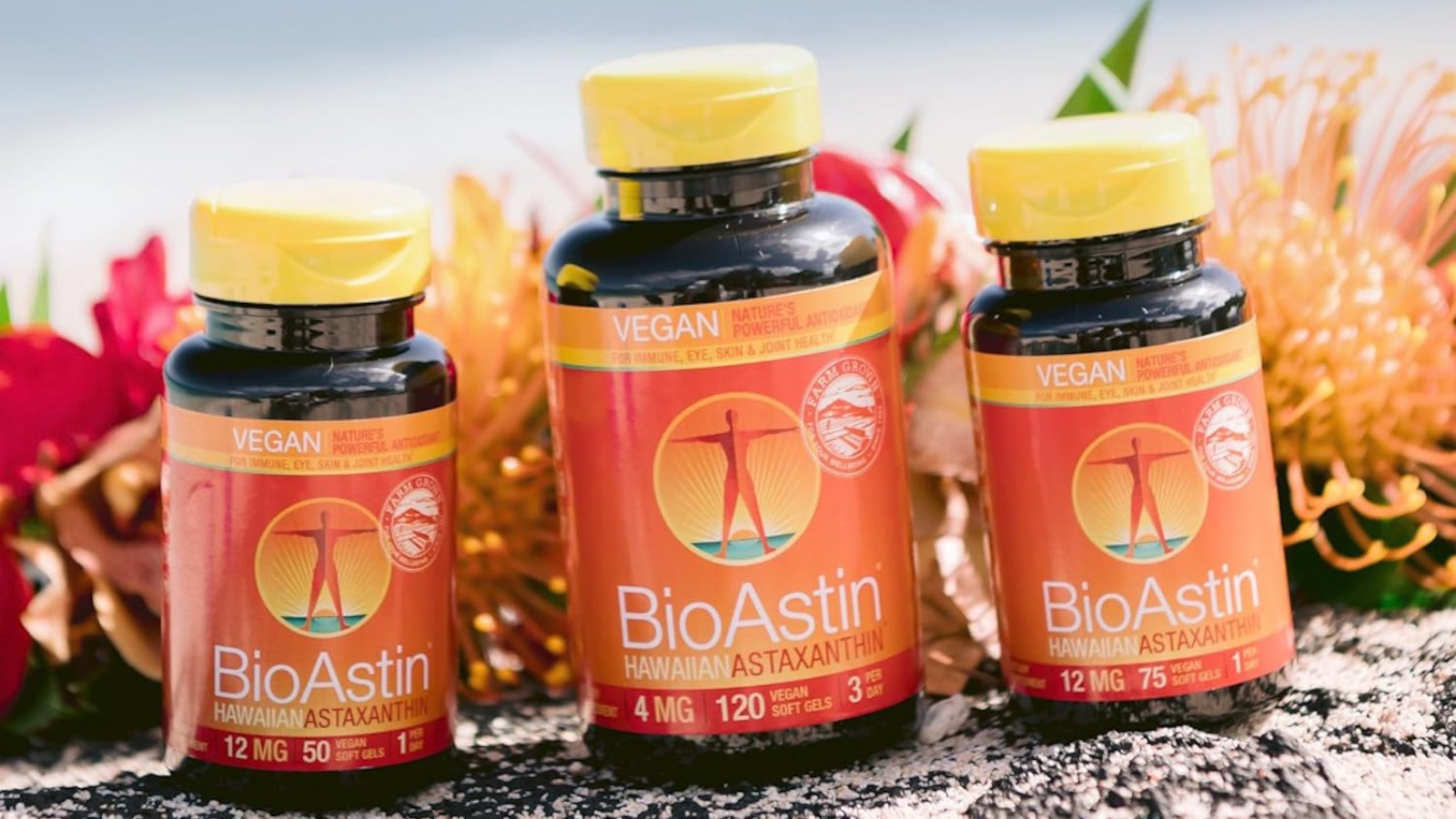
Not all astaxanthin supplements are created equal. Here’s what to look for:
- Natural vs synthetic: Choose natural astaxanthin derived from Haematococcus pluvialis. It’s more bioavailable than its synthetic versions.
- Dosage: Look for 4mg to12mg per serving. Start low and build up.
- Fat-soluble delivery: Astaxanthin is best absorbed with a meal containing healthy fat for better absorption. Some products include lipid carriers for this reason.
- Third-party testing: Choose brands that test independently for purity and potency.
- Sustainability: Microalgae-derived astaxanthin is often a more sustainable choice than fish-derived sources. Look for brands that are transparent about how they produce it.
The Nutrex BioAstin Hawaiian Astaxanthin range is available in a choice of strengths. Whether you’d prefer the convenience of the 12mg one-a-day softgel, the flexibility of the 4mg softgel for a lower starting dose, or the vegan BioAstin option, there’s something to suit every routine.
Is astaxanthin worth adding to my wellness routine?
Astaxanthin is not a passing trend. It’s a natural compound with a growing body of research behind it. The evidence suggests it may work at a cellular level across several areas of health at once.
The key benefits include:
- Skin health: reducing wrinkles, improving elasticity, enhancing hydration and UV protection
- Eye health: reducing eye fatigue and offering protective effects for retinal tissues
- Anti-inflammatory action: dampening chronic low-grade inflammation across multiple pathways
- Exercise recovery: reducing exercise-induced oxidative stress and shortening recovery time
- Antioxidant protection: uniquely spanning cell membranes and crossing key biological barriers
What makes astaxanthin particularly interesting is how these benefits connect. Less inflammation may mean better skin. Better mitochondrial function could mean more energy. Antioxidant support benefits your eyes, brain and skin all at once.
bodykind stocks a range of premium, natural astaxanthin supplements. Whether you’re focus is your skin, your eyes, your recovery or general resilience, there’s an option to suit you.
Consistency is key. Astaxanthin won’t work overnight, But with daily use, a good diet and sensible sun protection, the research suggests it may have a lot to offer.
The flamingos have known about it for years. Perhaps it’s time you got on board too.

Comments are closed here.