The Happy Lunchbox: Easy school snacks kids will actually eat
Packing a school lunchbox your child will actually eat, without spending your morning negotiating over sandwiches, is one of the quiet challenges of parenting. This guide breaks down what a balanced lunchbox really needs, how to handle fussy eating, and where hidden sugar likes to hide.
Contents
- Why does the lunchbox feel like such a daily challenge?
- Why does what my child eats at lunchtime matter for their afternoon?
- What happens to concentration and energy when lunch gets it wrong?
- What should actually go into a balanced lunchbox?
- How much protein, carbs and fat does my child really need at lunch?
- Why won't my child eat the healthy things I pack?
- How can I get my fussy eater to try new foods without a fight?
- Where is hidden sugar lurking in "healthy" lunchbox snacks?
- What are better swaps for crisps, chocolate bars and juice cartons?
- How can I prep lunchboxes without adding to my morning stress?
- What are some quick, no-fuss ideas for hectic school mornings?
Why does the lunchbox feel like such a daily challenge?
If you’ve ever stood in the kitchen at 7am wondering what on earth to put in your child’s lunchbox, you’re not alone. Most parents feel this, more often than they’d like to admit.
There’s a lot of pressure around school lunches. Pinterest tells you they should look beautiful. Nutritionists tell you they should be balanced. And your child, more often than not, tells you they just want the same three things on repeat.
It’s worth remembering that a good lunchbox isn’t about getting everything right, every single day. It’s about the general pattern over weeks and months, not any one Tuesday.
That said, food does matter here in a very real way. What you put in your child’s lunchbox has a direct effect on their energy, concentration, and mood through the afternoon. Get the balance right, and you’ll often notice the difference at pick-up time. Get it wrong occasionally, and nothing terrible happens. Your child is far more resilient than you might think.
Understanding what actually belongs in a balanced lunchbox, why fussy eating happens and what helps, where sugar hides in foods marketed as healthy, and how to make the whole process less stressful on busy mornings can turn lunchbox prep from a daily headache into something far more manageable.
Why does what my child eats at lunchtime matter for their afternoon?

Ask any teacher and they’ll tell you: the post-lunch slump is real. A dip in blood sugar around 2pm can turn a bright, chatty child into someone staring blankly at their worksheet. It’s not laziness. It’s biology.
Carbohydrates break down into glucose, which fuels the brain. Give your child a lunch built around refined carbs and little else, and that fuel burns fast, leaving them running on empty by mid-afternoon. Pair carbohydrates with protein and fibre, however, and the energy release slows right down.
Hydration plays a role too, and it’s easily forgotten. Water and milk support normal concentration levels, while sugary or fizzy drinks tend to work against it. Something as simple as swapping a juice carton for water can make a genuine difference to how alert your child feels by home time.
What happens to concentration and energy when lunch gets it wrong?
A lunch heavy in sugar and light on substance tends to follow a predictable pattern. There’s an initial spike, a burst of energy that might even look like enthusiasm, followed by a crash. That crash often lands right when your child needs focus most, during afternoon lessons or extracurricular activities.
Over time, a consistently unbalanced lunch can chip away at more than just afternoon energy. Nutrients like iron, zinc and B vitamins all play a role in attention and mood regulation. A child running low on these, week after week, may seem more irritable or less able to settle.
None of this means one “bad” lunch will derail your child’s day. Bodies are more forgiving than that. But the general pattern, built lunchbox by lunchbox, genuinely shapes how your child feels and functions through the school week.
What should actually go into a balanced lunchbox?
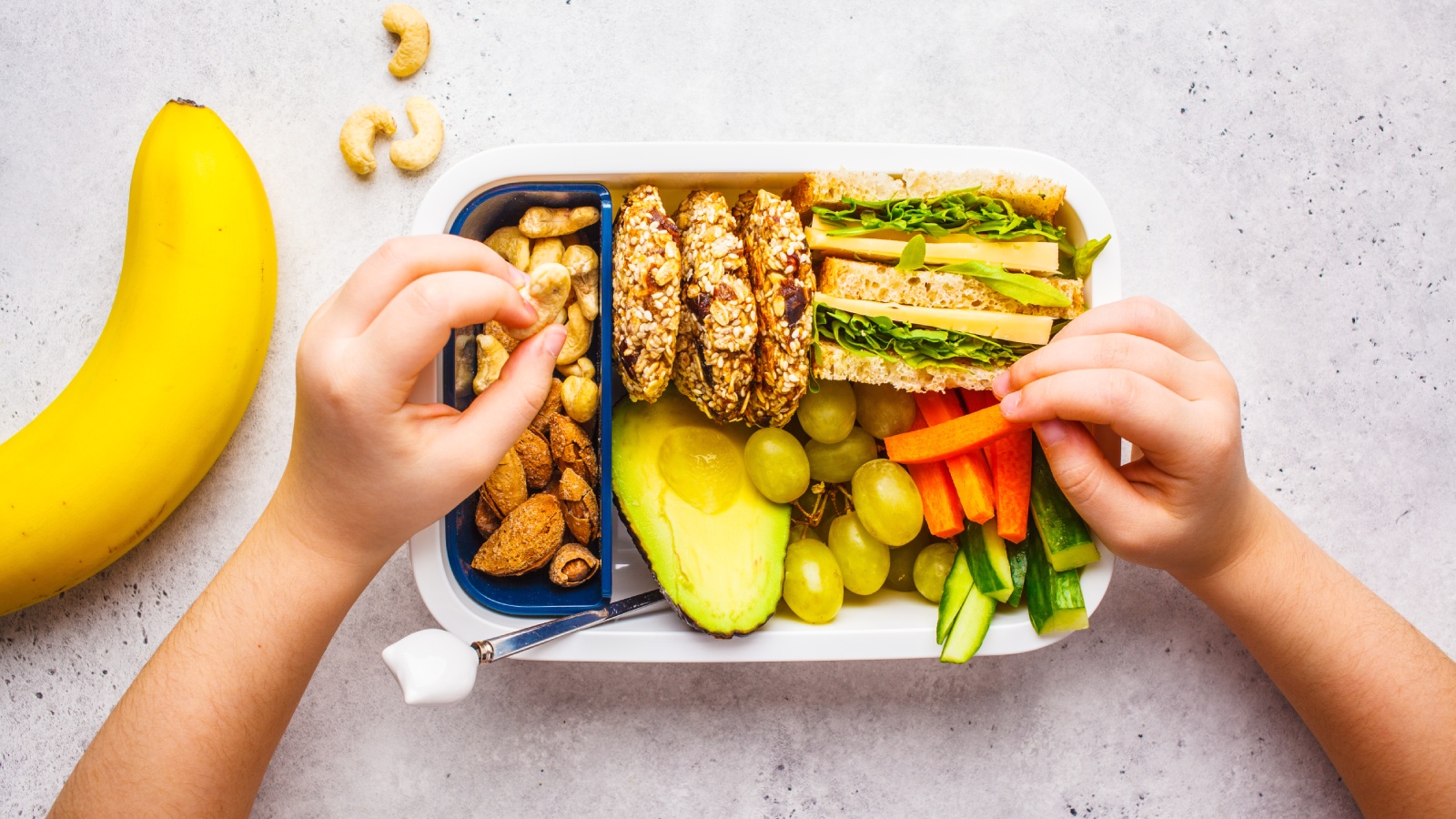
Strip away the Pinterest boards and bento box trends, and the actual guidance is refreshingly simple. A well-balanced lunchbox draws from four main food groups, and getting the ratio roughly right matters more than any single ingredient.
Here’s what that typically looks like:
- A starchy carbohydrate: wholegrain bread, pasta, rice or potatoes, ideally making up around a third of the box
- A source of protein: lean meat, fish, eggs, beans, pulses, hummus or cheese
- One or two portions of fruit or veg: fresh, tinned in juice, or blended into a dip
- A dairy or dairy alternative: yoghurt, cheese or a small carton of milk
Fibre deserves a mention too. It supports a healthy gut, and gut health has knock-on effects for immunity and even mood. Wholegrain options and a genuine portion of veg both help tick this box.
How much protein, carbs and fat does my child really need at lunch?
Precise numbers matter less here than balance and consistency. As a general guide, protein helps growing bodies build and repair, so including a decent portion at lunch (think a palm-sized amount of meat, fish or a plant-based alternative) supports steady energy through the afternoon.
Carbohydrates should form the largest part of the lunchbox, but wholegrain versions release energy more slowly than white bread or crackers. Fat isn’t the enemy either. Cheese, hummus, nut butters (school rules permitting) and oily fish all bring healthy fats that support brain development.
Rather than obsessing over exact portions, it’s worth thinking in weekly terms. If your child eats reasonably from each food group across five days, you’re doing better than you probably think.
Why won’t my child eat the healthy things I pack?
If this feels personal, it isn’t. Fussy eating is remarkably common, affecting a large proportion of toddlers and young children at some point. It’s often less about the food itself and more about your child asserting independence.
Texture, colour and temperature all play outsized roles in a young child’s food decisions. A soggy sandwich or a browning apple slice can be enough to trigger a full refusal, regardless of what’s inside. Frustrating as it is, this is largely normal developmental behaviour rather than defiance.
There’s genuine reassurance in the research too. Fussy eaters, on the whole, still tend to grow at a healthy rate. As long as your child is eating something from each of the main food groups across the week, there’s usually little cause for concern.
How can I get my fussy eater to try new foods without a fight?
Patience wins here, though it rarely feels that way in the moment. Some studies suggest children may need to encounter a new food numerous times, sometimes ten or more, before they’ll accept it. One refusal is data, not defeat.
A few approaches tend to help more than others:
- Serve new foods alongside familiar favourites, rather than as a standalone challenge
- Avoid hiding disliked foods inside meals, as this can breed suspicion of food generally
- Let your child help prepare or serve their lunch, which builds a sense of control
- Model the behaviour yourself, since children are far more likely to copy what they see you eat than what they’re told to eat
Staying calm matters too. Removing a rejected food without comment, then trying again another week, tends to work better than pressure or persuasion.
Where is hidden sugar lurking in “healthy” lunchbox snacks?
This is the bit that catches most parents out. Plenty of foods marketed as children’s snacks carry more sugar than the packaging lets on. Flavoured yoghurts are a classic offender. Some varieties contain the equivalent of several sugar cubes in a single small pot.
Cereal bars, fruit-flavoured snacks made mostly from concentrate, and flavoured milk drinks often fall into the same trap. They’re dressed up as wholesome, yet the ingredients tell a different story. Reading the label, rather than trusting the front-of-pack claims, makes a real difference.
For context, guidance on free sugars (the added kind, not sugar naturally found in whole fruit or milk) suggests daily limits that are lower than most people expect for young children. It doesn’t take much to reach that limit before the sandwich is even unwrapped.
What are better swaps for crisps, chocolate bars and juice cartons?
Nobody’s suggesting a total ban on treats. Food shouldn’t feel like a moral minefield. But a few simple swaps can shift the overall balance without your child noticing much difference at all.
- Crisps → plain rice cakes, homemade popcorn (from age five), or vegetable straws
- Chocolate bars → a small piece of dark chocolate paired with fruit, or a homemade oat bar
- Juice cartons → water, or milk, with fruit juice kept occasional rather than daily
- Flavoured yoghurt → plain or Greek yoghurt with a spoonful of fruit compote stirred through
Small, consistent swaps like these tend to matter more over months than any single dramatic overhaul.
How can I prep lunchboxes without adding to my morning stress?

Mornings are chaotic enough without lunchbox admin piled on top. The single biggest shift most parents can make is moving lunch prep out of the morning entirely. Packing the night before removes one major decision from an already pressured hour.
Batch-prepping helps too. Chopping a week’s worth of vegetable sticks, or portioning dips into small containers on a Sunday, turns five separate jobs into one. Keeping a small stock of freezer-friendly bread, wraps and bagels also means you’re never caught without a base.
A rough weekly plan, even a scribbled list on the fridge, takes the daily ‘what now?’ decision out of the equation entirely.
What are some quick, no-fuss ideas for hectic school mornings?
Some combinations come together in genuinely under five minutes, and still tick the balanced-lunchbox boxes:
- Wrap, hummus, cucumber sticks, grapes, cheese
- Pasta salad made from last night’s leftovers, plus a small pot of yoghurt
- Pitta pockets with cold chicken, salad, and a piece of fruit
- Bagel with cream cheese, cherry tomatoes, and a small tub of tinned fruit in juice
Involving your child, even briefly, tends to speed things up rather than slow them down. A child who’s chosen their own fruit or spread their own hummus is usually more invested in actually eating it come lunchtime.
There’s no version of lunchbox parenting that gets it perfect every single day, and that was never really the point. What matters is the shape of things over weeks, not the contents of any one box on any one Tuesday.
Understanding the building blocks, why fussy eating happens, where sugar hides, and how to make mornings easier gives you the tools to make small, sustainable changes. Your child doesn’t need a flawless lunchbox. They need a reasonably balanced one, made by a parent who isn’t drowning in guilt over the odd chocolate bar.
That’s a far more realistic, and honestly far kinder, standard to aim for.

Comments are closed here.